Hashrate Fluctuation and Payout Variance: What to Expect
Two miners with identical hardware can earn different amounts in the same week without either doing anything wrong. Variance in mined output comes from block timing, fee timing, uptime and difficulty retargets, and each payment method assigns those sources to a different party. At 300 TH/s the expected figure is 0.00014206 BTC a day — about $12.12 at $85,294 per BTC — and knowing which part of a shortfall is randomness rather than fault is the whole skill.

Key takeaways
- 300 TH/s expects 0.00000592 BTC an hour, so a four-hour outage costs about 0.00002367 BTC — roughly $2.02 — and not a rounded-off fraction of it.
- A 10% swing in a week's realised output at that hashrate is 0.00009944 BTC, about $8.48, which is well inside normal block-timing noise for a small pool.
- PPS+ removes block-timing variance from the block-reward component by settling per accepted share hourly; PPLNS leaves it with you across the last 5 difficulty rounds.
- Your own uptime is the only variance source you fully control, and it compounds: 95% uptime is a permanent 5% cut on every future payout.
Where the randomness enters
Block timing. A pool with a given share of network hashrate expects a calculable number of blocks. It will not find exactly that many in any short period, and the deviation grows proportionally larger as the period gets shorter. Pool Luck is the dashboard name for found blocks divided by expected blocks, and it surprises new miners most, because it can move a payout by double digits without a single machine changing state.
Fee content. The transaction-fee part of a block varies with mempool activity. Blocks found during a quiet hour carry less fee value than blocks found during a busy one, and the listed fee on that component is 2%, applied to whatever was collected rather than to a fixed amount.
Uptime. Every offline hour is a permanently lost hour, not a deferred one. A site with 95% availability forfeits 5% of its lifetime output, and that gap is invisible in a monthly total that is also being moved by difficulty and price.
Difficulty and price. Difficulty is retargeted on a roughly two-week cycle, and the estimate for the next adjustment — +1.90% at the time of writing — is already visible before it lands. Difficulty changes the value of every share; price changes the dollar value of the BTC those shares produce. Neither is variance you can manage, but both must be held constant before any comparison of two periods means anything.
Who absorbs which kind of variance
The payment method is the lever. On PPS+, the block-reward component is settled per accepted share at current difficulty and paid hourly, so block-timing variance is the pool's problem and the listed fee for that is 4%. The transaction-fee component is still distributed with PPLNS logic at a listed 2%, so some fee-timing variance remains. On PPLNS, both components are merged and paid only when the pool finds a block, following 6 confirmations and a split based on the last 5 difficulty rounds; the listed fee is 2%, and the miner carries the timing.
| Source | Magnitude at 300 TH/s | PPS+ | PPLNS |
|---|---|---|---|
| Block timing | A week can deviate by roughly 10% for a small pool | Pool | Miner |
| Transaction-fee content | Thin fee blocks shave the 2% component | Partly the miner | Miner |
| Uptime | Four hours offline is 0.00002367 BTC, about $2.02 | Miner | Miner |
| Difficulty retarget | Next estimate +1.90% on every share value | Shared | Shared |
| Price | $85,294 per BTC decides the dollar figure only | Neither | Neither |
Worked example: separating noise from a fault
Take 300 TH/s on PPS+ and a week in which the credited total came in 12% below expectation. The expectation is built from a network that mines 450 BTC a day against a hashrate implied by 132.76 T, which is 950.3 EH/s; 300 TH/s is a share of 3.16 × 10⁻⁷, worth 0.00014206 BTC a day, 0.00099442 BTC a week, and $84.81 a week at the price above.
Now attribute the 12% gap, which is 0.00011933 BTC, or about $10.18. Check uptime first: any offline hours during the week explain their exact share, and at this size each hour is 0.00000592 BTC, near $0.50. If the machines ran continuously, look at whether the transaction-fee component was thin, then look at whether your own submitted hashrate dipped while the pool's total held steady. Only if all three are clean does a 12% gap justify an enquiry, and by then you already know which party the missing BTC belongs to.
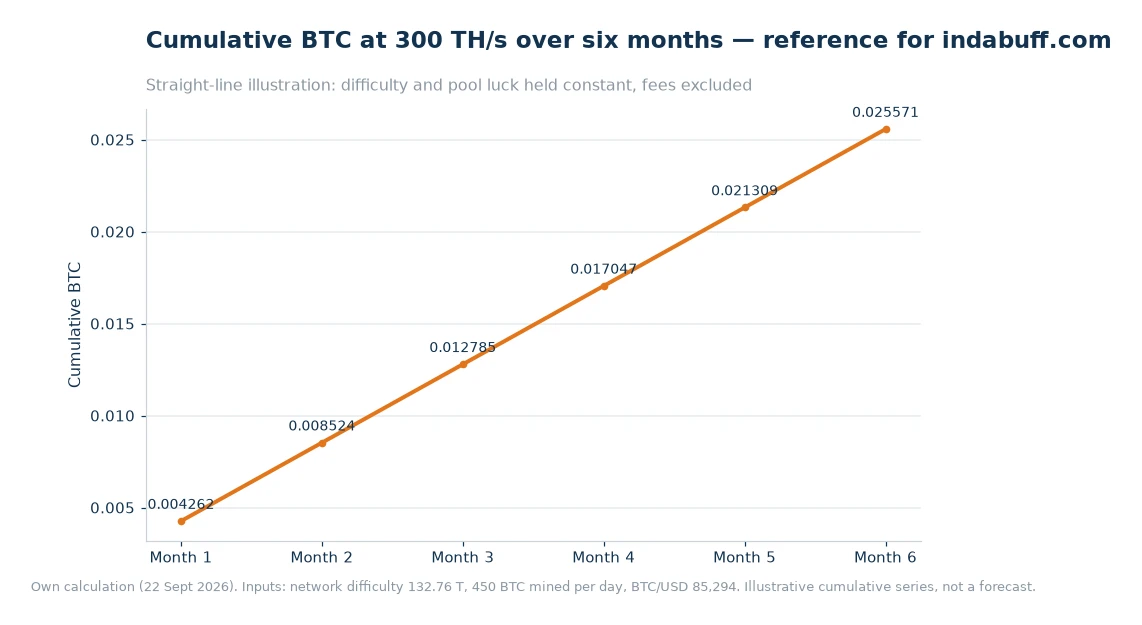
That line is not a forecast. It is a ruler. Once it is written down, a weekly figure that lands on it needs no explanation, and a figure that misses it can be broken into the three components above in a few minutes rather than argued about for a month.
One more habit makes the comparison cheaper: keep a second copy of the baseline for the hashrate you ran last quarter. A fleet that grew from 300 TH/s to 450 TH/s should show a step from 0.00014206 BTC a day to roughly 0.00021309 BTC, near $18.18, and a step that size should be datable to the day the extra machines were racked rather than discovered later as an unexplained drift.
What to measure monthly
Record three numbers every month: BTC credited, hours actually mined, and the difficulty that was in force. Divide credited BTC by hours to get BTC per hour, then compare that with the theoretical rate your hashrate implies. At 300 TH/s that rate is 0.00000592 BTC an hour, so the comparison is quick arithmetic rather than analysis.
Two outside readings help close the loop. The state view publishes ViaBTC Pool Hashrate with network hashrate and difficulty, so you can see whether the pool changed size while your own numbers held. The Miner Profitability Ranking is useful in the opposite direction: it shows what each ASIC model earns at current difficulty and price, which is the benchmark your own efficiency is actually competing against when power is the binding cost.
Frequently asked questions
How much day-to-day variation is normal?
More than most miners expect in short windows and much less in long ones. Weekly deviations of around 10% at a small pool are ordinary, while a monthly total that misses a corrected expectation by more than a few percent is worth investigating.
Does PPLNS pay more over time?
Its listed fee is lower — 2% on both components together rather than 4% on the block-reward part — but the miner carries block-timing risk across the last 5 difficulty rounds and waits for 6 confirmations. The difference in fees at 1 PH/s is about $24.23 a month, which is the amount you are paying to avoid that risk.
Why did my income drop if my hashrate did not?
Three candidates: difficulty rose at the last retarget, the transaction-fee component was thin, or part of your fleet went offline for a period you did not notice. Hashrate reported by the miner firmware will not show a machine that stopped submitting shares cleanly.
Write the expectation down, then compare against it
A month of numbers beats a year of dashboard impressions. Fix the baseline in writing, keep a per-worker view so a single machine cannot hide inside an average, and re-run the arithmetic when difficulty changes rather than when a payment looks small. Variance is unavoidable, but unexplained variance is optional — and the difference between the two is whether you did the division.
Data and sources: ViaBTC fee schedule[1], pool statistics and miner profitability pages[2][3]. Network difficulty 132.76 T, implied network hashrate 950.3 EH/s, the 3.125 BTC block subsidy, 144 blocks per day, an estimated next retarget of +1.90% and a BTC price of $85,294 were read from public chain data and market feeds; read 22 Sept 2026. All earnings figures are arithmetic on those inputs and change with difficulty, price and uptime.