KAS at Small Scale: 0.001 BTC in Weeks, Not Years
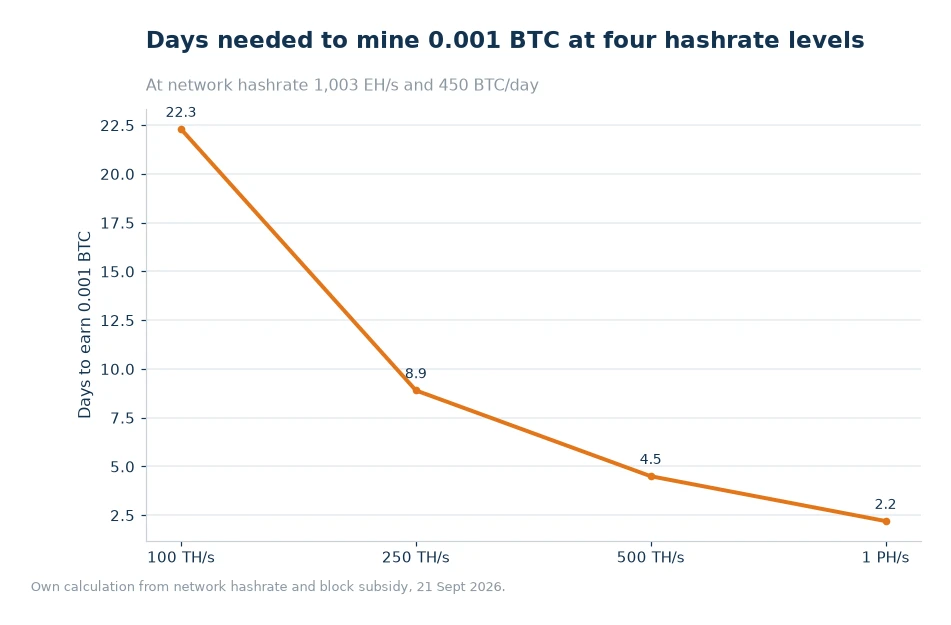
KAS rigs are often small, which makes a thousandth of a bitcoin a realistic checkpoint rather than a fantasy. At 100 TH/s of BTC-equivalent work the target takes 22.3 days; at 1 PH/s it takes 2.2 days. Both fit inside a difficulty period or two, so the run can be judged before the ground shifts.

Key takeaways
- 0.001 BTC takes 22.3 days at 100 TH/s and 2.2 days at 1 PH/s.
- The target is worth $84.69 at $84,692, or about 2,050 KAS at $0.04130647.
- A 22.3-day run spans one difficulty change, so the result is a fair test of a small rig.
- KAS sits alongside 20+ coins on one account, with hourly settlement under PPS+.
A target that fits inside a difficulty period
Difficulty adjusts roughly every two weeks on the BTC network, and a 22.3-day target crosses one or two of those boundaries. That is short enough that the inputs used at the start are still close to the inputs used at the end, which makes the result comparable with the prediction. A target that takes a year cannot be judged that way, because too much has changed by the time it lands.
For a KAS miner the same logic applies with a caveat: the KAS network has its own difficulty and its own schedule, so the BTC-equivalent target is a value check rather than a KAS output forecast. What it does well is answer whether the rig's daily value covers its running cost, which is the question that decides whether the machine stays plugged in.
Four levels, from three weeks to two days
Every row uses the same inputs: 450 BTC a day across a 1,003 EH/s network, or 0.00000044865 BTC per TH/s per day. The hours column is the days figure multiplied by 24.
| Hashrate | Daily BTC | Days to 0.001 BTC | Hours |
|---|---|---|---|
| 100 TH/s | 0.000044865 | 22.3 | 535.2 |
| 250 TH/s | 0.00011216 | 8.9 | 213.6 |
| 500 TH/s | 0.00022433 | 4.5 | 108.0 |
| 1 PH/s | 0.00044865 | 2.2 | 52.8 |
The spread is wide enough to matter for how often a miner should look. At 100 TH/s a weekly check catches a problem with days to spare. At 1 PH/s the target can complete between two checks, so the useful signal is the hashrate curve rather than the balance, and alerts matter more than calendars.
Worked example
Run the smallest row all the way to the electricity bill.
- 450 BTC a day ÷ 1,003,000,000 TH/s = 0.00000044865 BTC per TH/s per day.
- 100 TH/s × 0.00000044865 = 0.000044865 BTC a day.
- 0.001 BTC ÷ 0.000044865 = 22.3 days.
- 22.3 × 24 = 535.2 hours of continuous running.
- Power at 1.1 kW for 535.2 hours is 588.7 kWh, which at $0.08 per kWh costs $47.10.
- Gross value of the target: 0.001 × 84,692 = $84.69, leaving about $37.59 before fees.
- At 250 TH/s: 0.001 ÷ 0.00011216 = 8.9 days, and the same power draw costs $18.80 across 213.6 hours.
- At 1 PH/s: 0.001 ÷ 0.00044865 = 2.2 days, and 52.8 hours at 1.1 kW is $4.65 of power against $84.69 of value.
What a thousandth of a bitcoin looks like in KAS
A KAS miner does not receive bitcoin, so the target has to be translated. At $84,692 per BTC, 0.001 BTC is $84.69; at $0.04130647 per KAS that is roughly 2,050 KAS. The translation is rough because both prices move, but it gives an order of magnitude that a miner can compare with a real balance.
It also explains why a small KAS operation can feel unproductive. Two thousand KAS is a modest number of coins, and it arrives over three weeks at 100 TH/s. The coin count looks small while the dollar value looks ordinary, and neither view is wrong; they are just different units applied to the same credit.
Payout timing on a small balance
PPS+ is the default and settles the block-reward component hourly against current difficulty, with a listed 4% on that component and 2% on the transaction-fee part. For a rig earning a few dollars a day, hourly settlement means the balance moves often enough to see a problem quickly, which is the main practical benefit at this scale.
PPLNS pays after six confirmations and shares the miner's slice across the last five difficulty rounds at a listed 2% on the combined reward and fees. On a 22-day run the difference in listed rate is small, but the timing is lumpier, and a lumpy arrival is harder to compare with a fixed power bill. A miner testing a small rig usually wants the smoother series.
What the pool figures add for a small rig
Two numbers explain most of the week-to-week variation. The total hash the pool is working with sets how often the group should find blocks, and the ratio of blocks found to blocks expected shows whether the current stretch is running hot or cold. For a small miner neither changes the per-terahash rate, but together they explain why the balance moved the way it did.
The ViaBTC KAS Mining Pool page puts those readings beside the coin-level detail, so a KAS miner can check the group and the balance on one screen. A pool running below expectation for a fortnight is not a reason to move; a pool whose share of the network has fallen for six months is worth a closer look.
The three-week test, written down
Record the start date, the reported hashrate and the power draw. At the end of the run, divide the elapsed days by 22.3 at 100 TH/s, or by 8.9 at 250 TH/s, to get the ratio of prediction to outcome. A ratio between 0.9 and 1.1 means the rig is behaving; below 0.9 usually means downtime or a lower effective hashrate than the rating.
Keep the record even after the test passes. Three or four of these runs, spread across a season, produce a better estimate of real uptime than any single measurement, and the pattern shows whether the shortfall is a hot-month problem or a permanent setting.
Write the power figure down in the same place as the coin figure. A run that hits its target but spends half the value on electricity has passed the hashrate test and failed the operating one, and only the two numbers together show that. Two columns, one page, and the question answers itself at the end of three weeks.
Frequently asked questions
How long does 0.001 BTC take at 100 TH/s?
About 22.3 days at a 1,003 EH/s network, which is 535.2 hours of continuous running at 0.000044865 BTC a day before fees.
Is 0.001 BTC a useful test for a KAS rig?
Yes. The target is small enough to finish in about three weeks at 100 TH/s and large enough that daily share noise averages out, so a shortfall shows up while the setup is still easy to change.
Why is the figure given in BTC rather than KAS?
BTC is the common unit for comparing mining operations; the KAS balance depends on the KAS network difficulty and price, so the BTC-equivalent figure is a value check rather than an output forecast.
Finish the test before buying the next rig
A three-week run at 100 TH/s costs little and answers two questions: what the rig actually produces, and what it actually consumes. Both answers are needed before a second machine makes sense, because a setup that loses money at 100 TH/s will lose more of it at 1 PH/s unless something else changes.
The ViaBTC App keeps the hashrate curve and the balance on one screen for iOS and Android, which is enough to run the test without a spreadsheet. The Miner Profitability Ranking then shows what current models earn at today's price and difficulty, so the next purchase can be compared with the one already running.
Sources: the ViaBTC state, app and miner ranking pages, with chain data read 21 Sept 2026[1]. BTC network hashrate 1,003 EH/s, difficulty 132.76 T, 3.125 BTC per block, 144 blocks a day, BTC $84,692, KAS $0.04130647. Published 22 Oct 2026; day counts assume continuous uptime.